Cars Don't Fail Suddenly: Why Your Check Engine Light Is Already Too Late
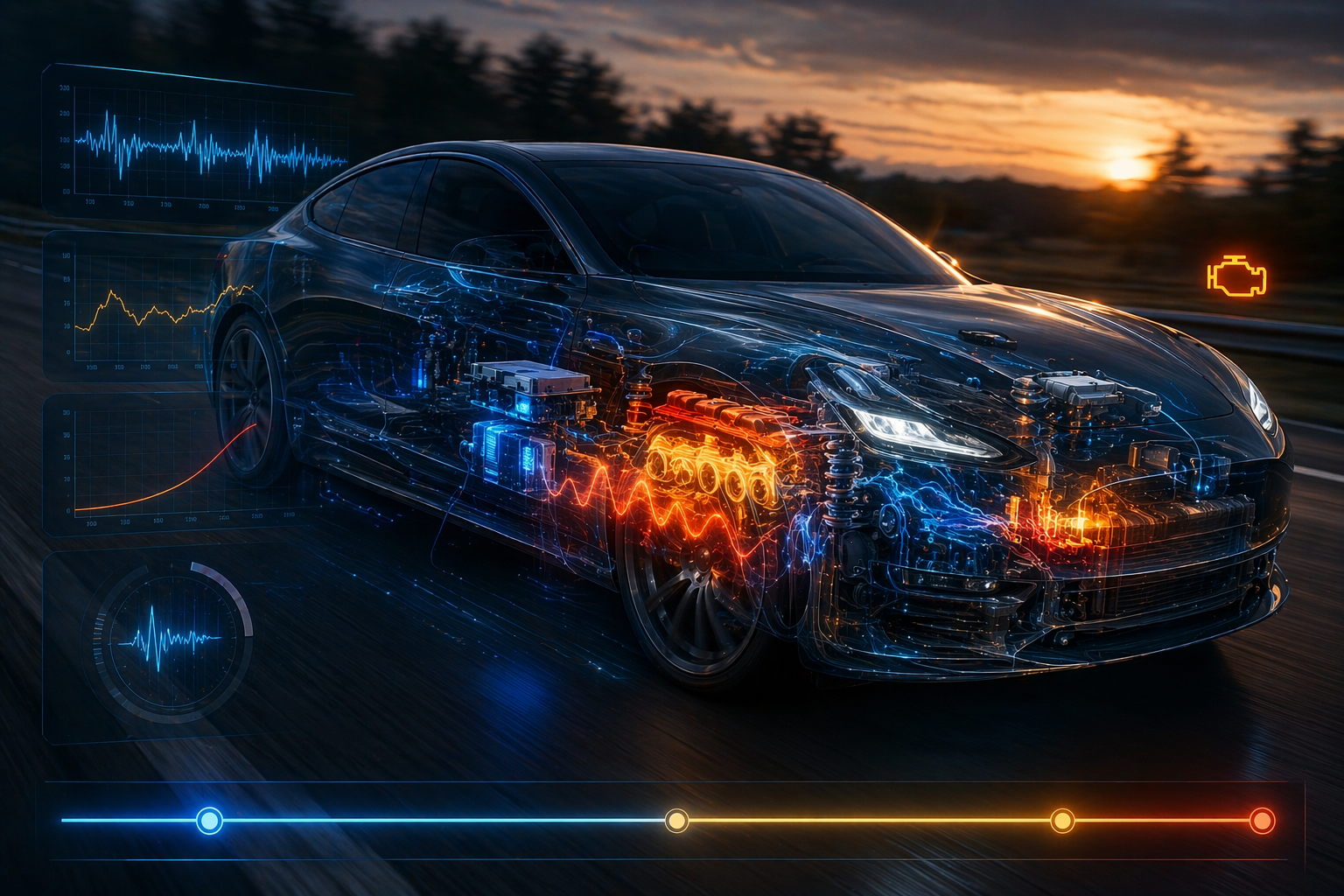
There's a myth every driver quietly believes: that vehicles fail without warning.
They don't.
By the time your check engine light flickers on, your car has been broadcasting distress for hours, sometimes days. The water pump didn't seize this morning — its bearing started oscillating 14 micrometers off-center on Tuesday. The alternator didn't give up at the intersection — its voltage ripple began climbing from 40 mV to 210 mV three days ago. The transmission didn't grenade itself — its fluid temperature crept 4 °C above the rolling baseline every trip for a week.
Every one of those signals is detectable. Most cars simply aren't listening.
The gap between "something is wrong" and "something has failed"
Mechanical systems fail gradually, then suddenly. In aerospace, this curve is called the P-F interval — the time between the Potential failure (first detectable anomaly) and the actual Functional failure. For most automotive components, the P-F interval is between 48 hours and 3 weeks.
Standard OBD-II diagnostics only trigger inside the last 2% of that interval. That's because they're thresholds, not trends. A code only fires when a sensor crosses a static value — coolant above 115 °C, oxygen sensor variance outside a fixed band, misfire count above a rate limit. By then, the damage is either occurring or has already occurred.
The Neural Sentinel looks at the other 98%.
Three signatures, one story
Take a failing water pump. OBD-II will notice it when the coolant hits 110 °C and stays there. Here's what our sensors see in the week before that happens:
Monday — Bearing vibration amplitude at the 220 Hz harmonic climbs from a baseline of 0.04 g to 0.09 g. Barely perceptible. No code.
Wednesday — Pulley-to-shaft oscillation begins introducing a 0.3 Hz wobble into the belt tensioner readings. Still no code.
Friday — Coolant flow rate, calculated from thermal gradient across the radiator, drops 6% versus the 30-day rolling baseline. Driver notices nothing. No code.
Sunday morning — Functional failure. OBD-II fires P0217. Now you're on the hard shoulder.
The Monday-to-Sunday window is where predictive maintenance lives. It's also where every breakdown we've ever prevented has been caught.
The 60Hz threshold
None of this is visible at 1 Hz sampling — the rate most factory telemetry runs at. A 1 Hz sensor sees one data point per second, which is enough to read a dashboard gauge but hopelessly blind to harmonic vibration patterns, microsecond voltage transients, or the subtle thermal signatures of a bearing starting to fail.
Our Sentinel Pro stream samples at 60 Hz. That's 5,184,000 data points per sensor per day. Enough to reconstruct the acoustic signature of a bearing, the waveform of an alternator's output, the pulse-width variance of a fuel injector — at the resolution those systems actually operate at.
And because every Vechtron-equipped vehicle contributes to a shared anomaly model, the network learns what "normal" looks like for your exact make, model, year, and drivetrain. A tiny deviation that a single-vehicle algorithm would miss becomes obvious when compared against the pulse of 500,000 peers.
What this looks like in your app
A notification, 48 hours before the failure: "Bearing vibration pattern on water pump assembly is trending toward failure. Estimated 2–4 days before functional degradation. Recommend scheduled replacement at convenience."
Not a red warning light at 70 mph on the motorway. A planned service appointment in your calendar. A cheaper part, because you're not paying for emergency labor. A trip that didn't get ruined.
That's what "proactive" actually means. Not pre-emptive anxiety — informed calm.
The wider picture
Reactive maintenance is the default because we've never had the instrumentation to do anything else. That's changing. Every domain that matters — aviation, manufacturing, power generation, spacecraft — moved to predictive maintenance decades ago, because the economics and safety case are overwhelming.
The automotive industry is finally catching up. The Neural Sentinel is how you catch up first, rather than when it's forced on you.
Your car has been trying to tell you something. For the first time, it has a voice you can understand.